
What is Unicode? The Secret Magic Behind Copy & Paste Fonts
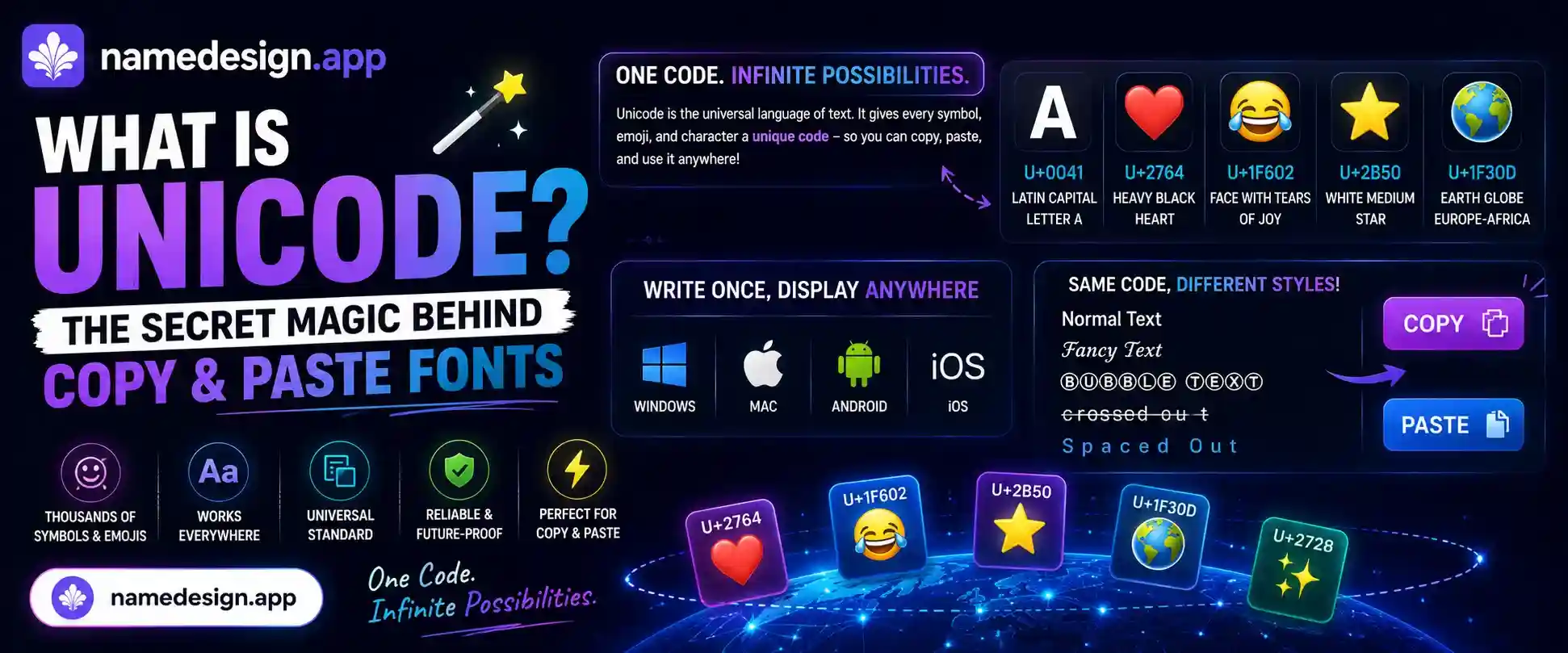
Table of Contents
Every single day, millions of people use websites like NameDesign.app to generate cool, aesthetic text for their Instagram bios, gaming usernames, and Discord chats. You type in a normal English word, hit a button, and suddenly it transforms into beautiful cursive, bold gothic letters, or upside-down text.
You copy it. You paste it. It works perfectly on your phone, on your friend's tablet, and on your desktop computer.
But have you ever stopped to wonder how that is actually possible? If you have ever tried to paste a custom downloaded font (like a fancy wedding script) from Microsoft Word into a Facebook post, you know it instantly reverts back to the boring, standard Facebook font. So why do our copy-and-paste fonts survive the jump between apps?
The answer lies in one of the most important, yet least understood, pieces of technology on the internet: Unicode. Let’s take a journey under the hood of the internet and discover why copy-and-paste fonts aren't actually fonts at all.
The Early Days: The Tower of Babel Problem
To understand the magic of Unicode, we have to rewind to the early days of computing. In the 1960s and 70s, computers were incredibly rudimentary. To a computer, letters don't exist. Computers only understand numbers (specifically, binary zeros and ones). If you wanted a computer to display the letter "A", you had to assign a specific number to it.
To standardize this, American scientists created something called ASCII (American Standard Code for Information Interchange). It was a very small dictionary. It assigned a number to the uppercase alphabet, the lowercase alphabet, the numbers 0-9, and a few punctuation marks. In total, ASCII had exactly 128 "seats" available.
For a while, this was fine. But as computers spread globally, a massive problem emerged. What if you were in Russia and wanted to type in Cyrillic? What if you were in Japan and needed Kanji? The 128 seats in ASCII were already taken by English letters. Computers couldn't talk to each other. An email sent from Tokyo to New York would arrive looking like a jumbled mess of random symbols.
Enter Unicode: The Universal Dictionary
By the late 1980s, brilliant minds in the tech industry realized they needed a bigger dictionary. They didn't need a dictionary with 128 seats; they needed a stadium with hundreds of thousands of seats, so every language on Earth could have its own specific number code.
This initiative became the Unicode Consortium. Today, Unicode is the universal standard for all text on the internet. Whether you are using an iPhone, an Android, a Windows PC, or a smart fridge, they all read the exact same Unicode dictionary.
Currently, Unicode contains over 149,000 unique characters. It includes almost every spoken language, historical dead languages (like Egyptian Hieroglyphs), mathematical equations, braille, and—crucially for us—emojis and specialized formatting symbols.
The "Hack": Why Our Fonts Work Anywhere
So, how does this relate to your customized Instagram bio? Here is the big secret: the text you copy from NameDesign.app is not a font.
A "font" (like Arial, Helvetica, or Times New Roman) is basically just a pair of digital glasses. It takes the standard English letter "A" and changes how it looks visually on your screen. But underneath, the computer still knows it is just a standard "A". When you paste it into Instagram, Instagram strips away your "glasses" and forces you to use their default glasses.
Unicode, however, is deeply embedded in the system. Remember how we said Unicode has over 149,000 seats? Way back in the day, mathematicians and scientists petitioned Unicode to add special characters for complex equations. They needed a bold "A", an italic "A", and a cursive "A" to represent different variables in physics and algebra.
Unicode agreed. They created entirely new, separate seats in the dictionary for these characters.
When you use our Cursive Text Generator, the code on our website isn't applying a font. It is running a script that takes the normal letter you typed, searches the massive Unicode dictionary for the mathematical cursive equivalent, and swaps them out.
Because these are actual, unique characters rather than just stylistic fonts, apps like Facebook, PUBG, and Instagram are forced to display them exactly as they are. They can't strip the styling away, because doing so would fundamentally change the character.
Pushing Unicode to the Limit: Blank Space & Zalgo
Once you understand that Unicode is just a massive list of symbols, you can start doing incredibly fun things with it.
For example, how do invisible names work in gaming? In the Unicode dictionary, there are specific characters meant to be used as formatting "fillers" for complex Asian languages. These characters are completely invisible, but because they have an official Unicode number, games register them as valid text. You can copy these directly from our Blank Text page to trick games into giving you an empty username.
Then there is the dark side of Unicode: Combining Characters. Certain languages, like Arabic, require symbols (like accents) to be drawn directly on top of, or below, a base letter. Unicode allows this by using special "combining marks."
The internet quickly realized that there is no limit to how many combining marks you can attach to a single letter. By aggressively stacking hundreds of these marks on top of standard English letters, you get messy, chaotic, glitchy text that spills all over the screen. This is widely known as Zalgo text, which you can easily create on our Zalgo Generator page to prank your friends in Discord.
The Mystery of the Empty Box (Tofu)
As flawless as Unicode is, you might occasionally paste a beautiful aesthetic name into an older game or a cheap Android phone, only for it to turn into a row of empty boxes: `[ ] [ ] [ ]`.
Graphic designers call these boxes "tofu." It happens because your specific device is missing the font file required to draw that particular Unicode symbol. To save space, mobile game developers often delete obscure Unicode symbols from their game code. If you paste a symbol the game doesn't have a drawing for, it panics and defaults to the empty box.
If this happens to you, don't worry. Just come back to NameDesign, pick a slightly simpler style (like our Bold or Italic options), and try again. The simpler the text, the more universally supported it is.
Final Thoughts
The next time you design a beautifully curated social media bio or craft a highly intimidating gaming clan tag, take a second to appreciate the technology making it happen. You aren't just typing; you are accessing a globally standardized library of human language and mathematics to make your digital identity truly your own.